

Why those positive statements you repeat each morning might be doing more than you think—and what science reveals about turning thoughts into action.
You've probably heard it before: "Just think positive thoughts and good things will happen." Maybe you've even rolled your eyes at the suggestion. After all, repeating "I am confident" while scrolling through anxiety-inducing news feeds seems about as effective as shouting at clouds.
But here's where it gets interesting—and where science parts ways with magical thinking.
What if I told you that neuroscientists at the University of Pennsylvania and UCLA have used brain scanners to watch, in real-time, what happens when people practice affirmations? That researchers have measured how specific brain regions light up during affirmation practice, and then tracked whether that neural activity predicts actual behavioural changes weeks later?
The results might surprise you. They certainly surprised the scientific community.
What Actually Happens When You Say "I Am Worthy"
Let's start with what affirmations actually are—and aren't.
Daily affirmations are intentional, positive statements that reflect your values, strengths, or aspirations. Think declarations like "I trust my creative intuition" or "I am building healthy boundaries." They're not magical incantations. They're not denial. And they're definitely not about ignoring real problems.
What they are, according to a comprehensive meta-analysis of 67 studies involving over 17,700 participants, is a scientifically validated tool for enhancing well-being, strengthening self-perception, and reducing psychological barriers like anxiety and negative mood. The effects aren't just feel-good fluff—they persist in long-term follow-ups, suggesting something more fundamental is changing in the brain itself.
For decades, mainstream psychology dismissed affirmations as pseudoscience. But functional MRI studies have fundamentally shifted that perspective. And the mechanism is fascinating.
Your Brain Has a "Self-Processing Network"—And Affirmations Activate It
Here's what happens inside your skull when you engage with a meaningful affirmation:
The Self-Related Processing System Lights Up
Your medial prefrontal cortex (mPFC) and posterior cingulate cortex (PCC) form what neuroscientists call the self-processing network —regions that activate whenever you think about yourself, contemplate personal goals, or imagine your future. When researchers scanned people's brains during value-focused affirmation exercises (like reflecting on creativity or connection), these regions showed significantly greater activity compared to people in control conditions.
This matters because the mPFC isn't just passively observing—it's actively constructing and updating your self-concept. When you practice affirmations related to purpose or growth, you're essentially telling this neural system: "Pay attention. This is important information about who I am."
Your Reward System Gets Involved
But the real revelation came from studying the brain's reward centres. The ventral striatum and ventromedial prefrontal cortex (VMPFC) —the same regions that activate when you anticipate something pleasurable—showed substantially elevated activity during affirmation practice.
In one landmark study , affirmed participants showed 0.102% neural signal change in these reward regions during value reflection, compared to only 0.012% in controls. That's an 8.5-fold difference.
Even more striking: when participants reflected on future-oriented affirmations (imagining a time in the future when they'd embody their values), the difference amplified dramatically. Affirmed participants showed 0.133% activation in reward regions versus -0.029% in controls—a 162% greater response.
Think about that for a moment. Your brain's reward system—the same circuitry involved in motivation, desire, and goal-pursuit—activates more strongly when you combine affirmations with future thinking. You're not just saying words; you're priming your brain to value and pursue goal-aligned outcomes.
The "Neurons That Fire Together Wire Together" Principle
This brings us to neuroplasticity—the brain's ability to physically reorganize itself based on experience.
There's a foundational principle in neuroscience, formalized by Donald Hebb in 1949 : "Neurons that fire together wire together." When you repeatedly activate a neural pathway—through repeated thinking, visualization, or affirmation—the synaptic connections between those neurons strengthen.
This isn't metaphorical. Brain imaging studies have demonstrated measurable changes in brain structure following consistent practice. The more you activate pathways associated with confidence, the easier it becomes for your brain to access confident thoughts and behaviours automatically.
In LightSeed, when you select affirmation types like resilience , self-compassion , or trust , you're not just reading nice words each morning. You're engaging in a daily practice that, over time, strengthens the neural pathways associated with those qualities. The brain literally begins to wire itself around these concepts.
Why Repetition Matters (And Why Once Isn't Enough)
Here's where the science gets practical: neuroplasticity requires repetition.
Research on distributed practice shows that spacing out learning sessions over time produces stronger, more durable neural changes than cramming everything into one session. This is why LightSeed delivers a fresh affirmation each day rather than having you repeat the same statement endlessly. Varied repetition within a theme (like receiving different gratitude affirmations across days) creates more robust neural networks than identical repetition.
Think of it like this: you're not building a single narrow path through a forest. You're creating a network of interconnected trails, all leading in the same general direction but with slightly different routes. This makes the overall destination (say, an abundance mindset or inner peace) accessible from multiple entry points.
The Reticular Activating System: Your Brain's Attention Filter
Now we get to one of the most misunderstood—and misappropriated—concepts in manifestation culture: the Reticular Activating System (RAS).
The RAS is a bundle of neurons 90219-9) in your brainstem that acts as an attention filter. Every second, your senses are bombarded with millions of bits of information. The RAS decides what makes it to your conscious awareness and what gets filtered out.
Here's the classic demonstration: Have you ever noticed that after you decide to buy a particular car model, you suddenly see that car everywhere? The cars were always there. Your RAS just wasn't flagging them as relevant until you programmed it to care.
This is where affirmations intersect with opportunity recognition. When you regularly practice affirmations related to abundance or purpose, you're essentially training your RAS to notice information, opportunities, and resources aligned with those themes. It's not magic—it's selective attention .
But—and this is crucial—the RAS doesn't create opportunities out of thin air. It helps you notice opportunities that already exist. The distinction matters.
The Dark Side of Positive Thinking: When Affirmations Backfire
Here's where we need to pump the brakes on uncritical affirmation enthusiasm.
Gabriele Oettingen's research at NYU revealed something counterintuitive: purely positive fantasising about the future can actually decrease motivation and achievement. People who only engaged in positive visualisation (without planning for obstacles) showed lower blood pressure and reduced energy—physiological markers of reduced motivation.
The problem? When you vividly imagine achieving a goal without acknowledging potential obstacles, your brain experiences a kind of premature reward satisfaction. It's as if you've already achieved the goal in your mind, reducing the psychological tension that drives action.
This explains why someone might repeat "I am financially abundant" while making zero changes to their spending habits or career trajectory. The affirmation provides a temporary mood boost but no behavioural momentum.
The solution isn't to abandon affirmations—it's to pair them with what Oettingen calls "mental contrasting": imagining both the desired outcome AND the obstacles you'll need to overcome. This creates what she terms "energised engagement" rather than complacent fantasizing.
What Makes an Affirmation Actually Work? The Evidence-Based Framework
So how do you practice affirmations effectively? The research points to several key principles:
1. Align With Your Values, Not Someone Else's Goals
Authenticity matters neurally . When affirmations feel personally meaningful, they activate the VMPFC more strongly. This is why LightSeed offers 16 different affirmation categories—from creativity to body acceptance to boundaries —so you can choose themes that genuinely resonate with your current journey.
If you're working on establishing healthier limits with others, affirmations about boundaries will likely feel more authentic and generate stronger neural responses than generic statements about wealth. Start where you are, not where social media tells you to be.
2. Make Them Future-Oriented
Remember that 162% greater reward system activation? That happened specifically with future-focused affirmations .
Instead of: "I am creative"
Try: "I am developing my creative voice and will express it more freely"
Instead of: "I have inner peace"
Try: "I am cultivating practices that bring me greater inner peace each day"
The future orientation engages your brain's mental simulation capacities and reward anticipation systems simultaneously—a powerful combination.
3. Engage Emotionally, Not Mechanically
Research distinguishes between mechanical repetition and emotionally engaged affirmation practice. Simply reading words off a screen while scrolling through emails activates different neural pathways than pausing, breathing, and actually connecting with the meaning.
When you open LightSeed each morning and see your daily affirmation, take 30 seconds. Read it slowly. Notice if it sparks any emotion—hope, resistance, curiosity. That emotional engagement is the neural signature that drives plasticity.
4. Pair With Concrete Action Steps
Here's the critical piece that separates science from wishful thinking: affirmations predict behavioural change only when they activate reward and self-processing networks —and those networks evolved to drive action , not passive hoping.
In the physical activity study I mentioned earlier, greater VMPFC activation during affirmation predicted significantly greater reductions in sedentary behaviour over the subsequent month. But here's what the researchers didn't do: they didn't tell participants to visualise being fit and then do nothing. The affirmation was paired with education about physical activity and tracking of actual movement.
If you're using affirmations about growth or purpose on LightSeed app, what's one small action you can take today that aligns with that affirmation? The affirmation primes the neural circuitry; the action reinforces it.
5. Practice Consistently, But With Variation
Spaced repetition creates stronger neural pathways than massed practice. This is why daily affirmations beat weekend affirmation marathons. But variation within a theme prevents habituation—your brain stops responding to stimuli it deems predictable and unchanging.
LightSeed's approach of providing different affirmations within your selected categories each day leverages this principle. If you've chosen confidence and self-compassion , you'll receive varied statements across those themes, keeping the practice fresh while still building the core neural pathways.
From Neural Activity to Real-World Change: The Full Picture
Let's connect all the dots with a concrete example.
Imagine you've chosen boundaries and worthiness as your affirmation types in LightSeed. Here's what's happening at multiple levels:
Neural Level:
Each morning's affirmation ("I honour my needs and communicate them clearly" or "I deserve to protect my time and energy") activates your mPFC (self-processing) and VMPFC (reward/valuation). Your brain begins to encode "healthy boundaries" as a positively-valued outcome.
Attention Level:
Over days and weeks, your RAS is reprogrammed. You start noticing situations where boundary-setting is needed (which you might have overlooked before). You notice articles, conversations, or examples of healthy boundaries. Your attention filters shift.
Emotional Level:
Because you're engaging emotionally with these affirmations, not just reading mechanically, emotional processing regions strengthen their connection to boundary-related concepts. Setting a boundary begins to feel less like conflict and more like self-care.
Behavioural Level:
When a boundary-testing situation arises, the neural pathways you've been strengthening make boundary-affirming thoughts and behaviours more accessible. You're more likely to speak up, say no, or communicate your needs. This isn't magic—it's that your brain has practiced this pattern repeatedly through affirmation.
Reinforcement Level:
Each successful boundary you set provides real-world reinforcement, further strengthening these pathways through dopamine-mediated reward learning . The affirmation practice and real experience create a positive feedback loop.
This is how affirmations contribute to "manifestation"—not through cosmic ordering, but through changing neural architecture, attention filters, emotional associations, and behavioural probabilities.
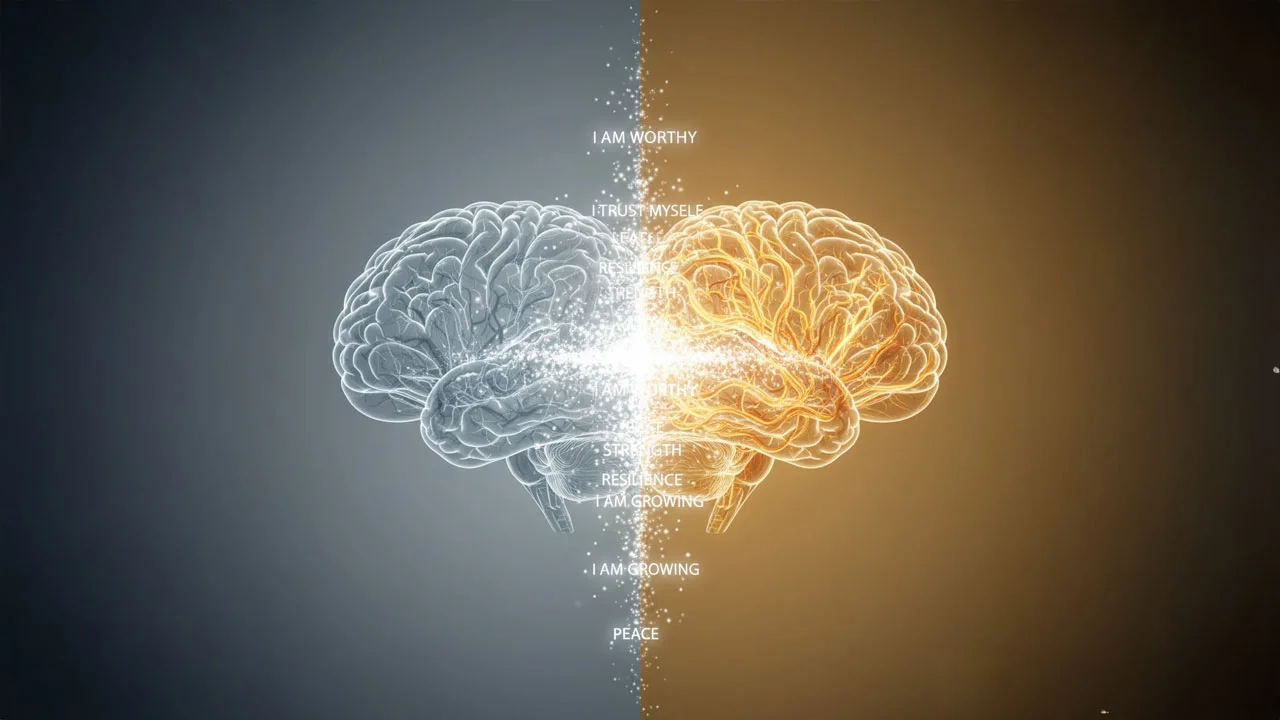
The LightSeed Approach: Affirmations Grounded in Science
At LightSeed, our affirmation system is built on these neuroscientific principles:
16 Evidence-Based Categories
We offer affirmations across categories that correspond to well-researched psychological constructs: creativity , confidence , self-compassion , inner peace , presence , abundance , purpose , boundaries , growth , connection , body acceptance , trust , release , worthiness , gratitude , and resilience .
Each category targets specific neural networks and psychological capacities supported by research.
Personalised Selection
You choose which affirmation types appear in your daily rotation. This ensures authenticity—you're working with themes that genuinely matter to you right now, maximising the VMPFC activation that drives behavioural change.
Daily Delivery, Varied Content
Fresh affirmations each day prevent habituation while building core pathways through spaced repetition. You can also save affirmations that particularly resonate, creating your own collection for deeper reflection.
Integrated With Journaling
Affirmations work best when paired with reflection and action planning. That's why LightSeed integrates affirmations with journaling, mood tracking, and goal management—you can write about how today's affirmation applies to your life, track your emotional state, and set concrete goals aligned with your affirmed values.
Offline-First, Privacy-Focused
Your affirmation practice is personal. All data stays on your device first, syncing securely to the cloud only when you're online. No one else sees your selected types or saved affirmations.
The Bridge Between Affirmation and Achievement
Let me be direct: affirmations alone won't manifest a new job, heal a relationship, or create financial abundance. Anyone claiming otherwise is either misunderstanding the science or deliberately misleading you.
But here's what affirmations can do, according to rigorous neuroscientific research:
- Activate brain systems involved in self-processing and reward valuation (Cascio et al., 2016 )
- Create measurable changes in neural pathways through neuroplasticity (Leuner et al., 2009 )
- Reprogram attention filters to notice goal-aligned opportunities (Moruzzi & Magoun, 1949 90219-9))
- Buffer against stress and threat, maintaining cognitive resources (Cohen & Sherman, 2014 )
- Predict actual behavioural changes when paired with action (Falk et al., 2015 )
Think of affirmations as preparing the neural soil. You still need to plant seeds (set goals), water them (take action), and tend the garden (persist through challenges). But affirmations ensure the soil is rich, receptive, and ready.
Your Affirmation Practice Starts Now
The question isn't whether affirmations work—the neuroscience is clear that they do, through specific and measurable mechanisms. The question is whether you'll practice them in a way that actually leverages those mechanisms.
Will you choose affirmations that authentically align with your values, or just repeat whatever sounds good?
Will you engage emotionally and reflect deeply, or scroll past them on autopilot?
Will you pair your affirmations with concrete actions, or treat them as substitutes for real effort?
Will you give the practice enough time for neuroplasticity to work its magic, or expect instant transformation?
The brain you have today isn't the brain you'll have in three months if you consistently practice affirmations, journal about your growth, track your emotional patterns, and align your daily behaviours with your affirmed values.
Start with one category that speaks to where you are right now. Maybe it's resilience if you're navigating challenges. Maybe it's trust if you're learning to listen to your intuition. Maybe it's release if you're ready to let go of what no longer serves you.
Your brain is already changing, whether you're conscious of it or not. Affirmations give you the opportunity to participate in that change intentionally.
The neurons are ready to fire. Are you ready to wire them together?
References & Further Reading
- Psychological Interventions for Resilience - Comprehensive meta-analysis of self-affirmation effects across 67 studies with 17,700+ participants
- The Law of Attraction: Science or Pseudoscience? - Critical examination of manifestation claims
- Meta-analytic review of self-affirmation interventions - 129 independent tests showing significant improvements in well-being
- Self-affirmation activates brain systems associated with self-related processing and reward - Cascio et al. (2016) fMRI study of neural mechanisms
- Cortical midline structures and the self - Northoff & Bermpohl (2004) on self-processing networks
- The brain's default network and its adaptive role in internal mentation - Buckner et al. (2008) on mPFC functions
- Self-affirmation alters the brain's response to health messages and subsequent behavior change - Falk et al. (2015) landmark PNAS study
- Self-affirmation alters the brain's response to health messages - Detailed neural signal data from Falk study
- Future-oriented affirmation amplification effects - Temporal orientation findings from Falk et al.
- The representation of abstract reward in the ventromedial prefrontal cortex - Boorman et al. (2009) on VMPFC encoding
- Past-oriented vs future-oriented affirmation effects - Temporal asymmetry findings
- Neural correlates of personal goal processing during episodic future thinking - Stawarczyk & D'Argembeau (2015) meta-analysis
- Self-affirmation alters the brain's response to health messages and subsequent behavior change - Complete Falk et al. PNAS study
- Neural activity predicts sedentary behavior changes - Behavioral prediction data from Falk study
- Future-oriented VMPFC activity predicts behavior change - Follow-up analysis from Falk et al.
- Mediation analysis of affirmation effects - Indirect effects through neural pathways
- The Brain That Changes Itself: Stories of Personal Triumph from the Frontiers of Neuroscience - Doidge (2007) popular neuroscience
- The Organization of Behavior: A Neuropsychological Theory - Hebb (1949) foundational work on neural learning
- Structural plasticity and hippocampal function - Leuner et al. (2009) on neuroplasticity mechanisms
- Distributed practice in verbal recall tasks: A review and quantitative synthesis - Cepeda et al. (2006) meta-analysis on spaced repetition
- The Science and Soul of Affirmations Through Neuroplasticity - Practical guide to neuroplasticity and affirmations
- Social: Why Our Brains Are Wired to Connect - Lieberman (2013) on social neuroscience
- Gorillas in our midst: Sustained inattentional blindness for dynamic events - Simons & Chabris (1999) classic attention study
- The molecular biology of memory storage: A dialog between genes and synapses - Kandel (2001) Nobel Prize work
- Short-term meditation induces white matter changes in the anterior cingulate - Tang et al. (2010) on rapid neural changes
- Brain stem reticular formation and activation of the EEG 90219-9) - Moruzzi & Magoun (1949) foundational RAS research
- The Reticular Activating System: A Key to Manifestation - Popular explanation of RAS mechanisms
- Multiple dopamine functions at different time courses - Schultz (2007) comprehensive dopamine review
- The motivating function of thinking about the future: Expectations versus fantasies - Oettingen & Mayer (2002) on positive thinking pitfalls
- Rethinking Positive Thinking: Inside the New Science of Motivation - Oettingen (2014) mental contrasting framework
- Manifesting vs Goal-Setting: What Actually Works According to Psychology and Neuroscience - Critical comparison of approaches
- The Science Behind Self-Affirmations - Psychology Today overview
- The Science Of Affirmations: The Brain's Response To Positive Thinking - MentalHealth.com guide
- Self-affirmation alters the brain's response to health messages and subsequent behavior change - Falk et al. complete study
- The psychology of change: Self-affirmation and social psychological intervention - Cohen & Sherman (2014) Annual Review
- Self-Affirmations Build Your Personal and Moral Resiliency - ONS Voice practical guide
- Self-affirmations provide a buffer against identity threat - Critcher & Dunning (2015) on protective effects
- Affirmation Authenticity and Effectiveness - Psychology Today research archives (February 2026)
- Social: Why Our Brains Are Wired to Connect - Lieberman (2013) on emotional engagement
- How Affirmations Rewire Brain Pathways - Upskillist practical guide
- Manifesting Your Goals From a Critical Thinking Standpoint - Psychology Today critical analysis